
What Are You Looking For?
What Are You Looking For?

Choosing a silicone hose for fuel or chemical service starts with the fluid, not the product label. A hose compatible with a particular gasoline blend may be unsuitable for a cleaning solvent, while a hose described as chemical-resistant may not be suitable for fuel transfer.
The distinction is one of scope. Fuel resistance addresses compatibility with specified fuels. Chemical resistance is a broader term covering compatibility with specified substances, which can include fuels, oils, solvents, acids, and alkalis. These requirements can overlap, so the same hose construction may serve both purposes when verified for the intended conditions.
Key Takeaways
What Is a Fuel Resistant Silicone Hose?
A fuel resistant silicone hose uses a fluid-contact material selected to tolerate specified fuels under defined conditions. Depending on the application, this may involve a fluororubber (FKM) or fluorosilicone (FVMQ) lining combined with reinforced silicone.
Standard silicone offers useful flexibility and temperature resistance, but these properties do not establish fuel compatibility. An incompatible fluid may cause swelling, softening, or loss of mechanical strength. Excessive permeation through the hose wall can create a separate performance concern.
A suitable lining provides the fluid-contact surface, while the reinforcement and outer layers contribute to the hose's mechanical and environmental performance. The complete construction, not just the lining material, must suit the application.
Fuel formulations also matter. Gasoline, diesel, and fuels containing alcohol or bio-derived components should not be treated as interchangeable media. Compatibility must be checked against the actual formulation.
Oil resistance is a related but separate consideration. Confirmed compatibility with a lubricant does not automatically establish suitability for a fuel, or vice versa.
What Is a Chemical Resistant Hose?
A chemical resistant hose is designed to withstand contact with identified chemicals or process fluids. Depending on its lining and construction, it may be suitable for selected acids, alkalis, solvents, oils, fuels, or coolants.
The term does not mean universal compatibility. A material that performs well with a petroleum-based fluid may be unsuitable for a ketone solvent or alkaline cleaning solution. Even fluids within the same broad chemical group can affect an elastomer differently.
The key question is therefore:
Resistant to which chemical, at what concentration and temperature, and for how long?
A category description helps identify possible products. It does not replace confirmation for the intended medium and exposure conditions.
Fuel Resistance vs. Chemical Resistance: The Practical Difference
| Selection Point | Fuel Resistant Silicone Hose | Chemical Resistant Hose |
| Primary focus | Compatibility with specified fuels | Compatibility with specified chemicals or mixtures |
| Fluid information needed | Fuel formulation and relevant blended components | Chemical identity, concentration, and mixture composition |
| Possible overlap | May also tolerate certain oils or other chemicals | May also tolerate certain fuels |
| Evidence required | Fuel-specific compatibility and application data | Chemical-specific compatibility and application data |
These terms describe performance requirements, not two mutually exclusive product types. A lined silicone hose may appear in both categories if its suitability has been verified for the relevant fluids and service conditions.
For example, if a hose will carry a specified fuel blend, use that formulation as the starting point, not a general "chemical-resistant" label. If it will also carry a cleaning fluid, evaluate that fluid separately rather than assuming verified fuel compatibility covers both.
The practical distinction is not which category sounds more capable. It is which proposed construction has evidence supporting the intended service.
FKM vs. FVMQ: Choosing a Lining
FKM and FVMQ are different elastomer families. Both may be considered for applications involving selected fuels or oils, but their strengths and limitations differ.
FKM: Fluoroelastomer
FKM is commonly considered where resistance to many fuels, petroleum oils, and other hydrocarbons is required.
Its properties vary with polymer composition and compound formulation. A general FKM designation therefore does not establish compatibility with every fuel or chemical. Conventional grades have important limitations with media such as ketones, strong bases, and amines.
When evaluating an FKM-lined hose, ask for information on the proposed compound and its suitability for the actual fluid rather than relying only on the material name.
FVMQ: Fluorosilicone
FVMQ combines silicone-like characteristics with improved resistance to selected hydrocarbon fuels and petroleum oils. Its low-temperature flexibility can also be useful where cold-service performance is important.
However, improved fuel resistance does not make FVMQ a universal chemical lining. Alcohols, ketones, and amines are among the media that require particular scrutiny, and compatibility must be checked for the proposed compound.
How to Narrow Down the Options
Start with the fluid-contact requirement. Screen the proposed FKM and FVMQ compounds against the exact medium, then compare suitable candidates for temperature range, flexibility, and the mechanical demands of the hose assembly.
If neither compound is suitable, consider another lining or hose material rather than forcing a choice between the two.
General compatibility charts help with initial screening. Final selection should address the specific compound and finished hose construction.
How to Select the Right Hose
A clear specification gives the manufacturer a basis for recommending and evaluating a construction. Work through the following requirements before finalizing a product.
Identify Every Fluid the Hose Will Contact
Specify the exact fuel, oil, chemical, or mixture. Include concentration, relevant additives, and a safety data sheet where available.
List flushing and cleaning fluids separately. A hose may encounter several media during its service life, even when it normally carries only one process fluid.
Define Temperature and Exposure
Provide normal operating temperatures and any short-duration peaks. Where relevant, distinguish the temperature of the fluid from the surrounding environment.
Also state whether exposure involves continuous transfer, intermittent flow, residual fluid, vapor, or external splashes. These are different conditions and should not be treated as equivalent.
Establish Mechanical Requirements
Specify working pressure and any vacuum requirements, along with dimensions, bend radius, vibration, and repeated movement.
Chemical compatibility does not establish whether a hose can withstand these loads. The lining, reinforcement, fittings, and installation arrangement must work together as an assembly.
Check Application-Specific Requirements
Identify any applicable standards, customer specifications, or performance limits.
For fuel service, these may include permeation requirements. A "fuel-resistant" description alone is not proof that a hose meets a particular fuel-line specification.
For other industrial applications, cleaning procedures, contamination limits, or electrical requirements may also affect the appropriate construction.
Agree on Verification
Ask what supports the proposed recommendation: compound compatibility data, testing of the finished hose, or experience under comparable conditions.
Where uncertainty remains, agree on a validation plan before approving production. Testing should reflect the intended fluid, temperature, exposure duration, and mechanical demands as closely as practical.
Common Selection Mistakes
Choosing by Category Name Alone
A product label is a starting point, not a complete specification. Two differently named products may share a construction, while similarly named hoses may use different compounds. Always check the actual material and product details.
Confusing Splash Resistance with Continuous-Service Suitability
Brief external contact is not equivalent to prolonged internal exposure. State how the fluid contacts the hose rather than simply describing it as "exposed to fuel" or "exposed to chemicals."
Applying a Temperature Limit to Every Fluid
A listed temperature range does not independently establish chemical compatibility throughout that range. Confirm the proposed service temperature for the actual medium.
Treating Material Data as an Assembly Rating
A compatible lining does not establish the pressure rating or service life of the complete hose. Reinforcement, connections, dimensions, and installation conditions also require review.
Lined Silicone Hose Options for Fuel and Chemical Service
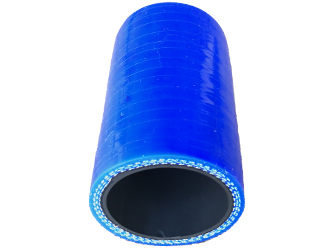
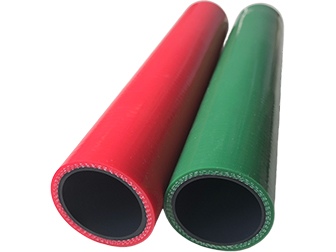
When comparing FKM- and FVMQ-lined hoses, evaluate each proposed compound against the intended fluid and operating conditions rather than relying on the material family name alone.
Rainbow Manufacturing's product information describes both fluorosilicone-lined and fluororubber-lined silicone hose options. Its current fuel-resistant and chemical-resistant category pages both list the same Fluororubber (VITON) Lined Silicone Hose Fuel Cell Hose, rather than two separate products. The listed construction features an FKM inner lining, a silicone outer layer, and aramid fiber reinforcement. For this product, the manufacturer specifies a maximum temperature of 250°C (482°F). This rating does not establish compatibility with every fuel or chemical at that temperature.
Fluorosilicone-lined hoses are also mentioned in the company's product information, but their specifications should be evaluated separately according to the intended application.
Have a Drawing or Sample? Contact Rainbow Manufacturing for Custom Hose Solutions.
Frequently Asked Questions
What Is the Difference Between Fuel Resistance and Chemical Resistance?
Fuel resistance refers to compatibility with specified fuels, while chemical resistance covers a wider range of substances, including fuels, oils, solvents, acids, and alkalis. Since fuel resistance is one aspect of chemical compatibility, the two requirements can overlap. Actual suitability depends on the fluid and operating conditions.
Is FKM Better Than FVMQ for Fuel Applications?
Not in every application. Compare the specific compounds against the fuel formulation, temperature range, exposure conditions, and required hose properties. The material family name alone is not enough to select a finished hose.
Can Standard Silicone Hose Be Used for Chemical Transfer?
It may be suitable for some fluids, but suitability must be established for the specific medium. Standard silicone should not be assumed appropriate for prolonged contact with fuels, petroleum oils, or aggressive chemicals.
What If Neither FKM Nor FVMQ Is Suitable?
Consider a different lining or hose material. The objective is to meet the service requirements, not to select silicone regardless of compatibility.
Looking For A Reliable Business Partner For Your Next Project?

Business Enquiries
+86 15160066997