
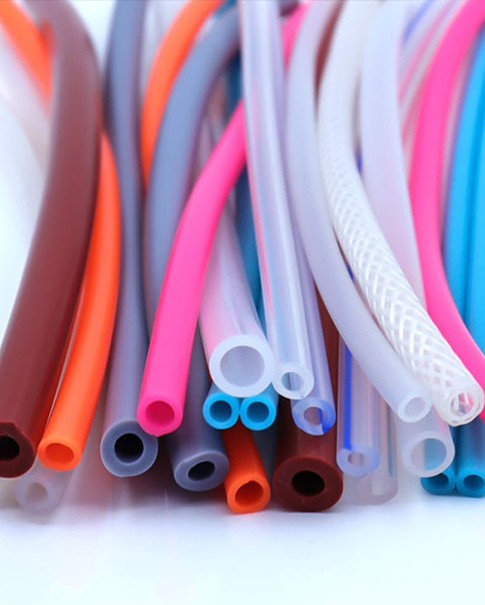

Modern fluid and air routing systems are rarely as simple as connecting two pipes in a straight line. Automotive cooling systems, turbocharger assemblies, charge air systems, industrial equipment, and other mechanical applications often have limited installation space, different connection diameters, and changing pipe directions.
This is where a well-designed universal silicone coupler can make a practical difference. Rather than forcing rigid pipes into an unsuitable position, silicone couplers can provide a flexible connection between components while helping engineers manage changes in diameter, angle, and routing direction.
For buyers and engineers, however, choosing the right coupler is not simply a matter of selecting a silicone connector that fits the pipe diameter. The shape, reinforcement, operating environment, available installation space, and required connection geometry all need to be considered.
RAINBOW Manufacturing provides a range of silicone couplers and custom silicone hose solutions for different routing requirements. Its Universal Silicone Coupler category includes straight couplers, reducers, 45-degree elbows, 90-degree elbows, hump hoses, and other custom-shaped couplers.
Why Silicone Couplers Matter in Modern Hose Systems
A coupler is often a relatively small component within a larger system, but its design can affect how easily the entire assembly can be installed and maintained.
Rigid pipes are useful where fixed routing and structural stability are required. However, they can become difficult to install when components are offset from one another or when a pipe needs to change direction within a confined space.
Silicone couplers offer a degree of flexibility that makes them useful for these transition points. Depending on the design, a coupler can help connect:
- Pipes with different outside diameters
- Components positioned at different angles
- Rigid metal or plastic pipes
- Intake and charge-air components
- Coolant system components
- Turbocharger and intercooler piping
- Equipment with restricted installation space
The key is matching the coupler geometry to the actual routing problem. For example, a straight coupler may be appropriate when two pipes are aligned. A reducer is more suitable when their diameters differ, while an elbow is useful when the connection needs to turn through a defined angle.
Universal Silicone Coupler vs. Custom-Shaped Coupler
The term "universal" does not necessarily mean that one coupler can solve every installation problem.
In practice, universal silicone couplers are better understood as a broad product family covering common connection geometries. Standard shapes can simplify sourcing and reduce unnecessary customization when the application follows a conventional layout.
However, real-world equipment often has more complicated routing requirements. An engine bay may contain multiple components competing for the same installation space. Industrial machinery may require a hose to pass around structural elements. A cooling system may have pipes positioned at different heights or with different connection diameters.
In these situations, a custom silicone hose coupler can be more appropriate than trying to adapt a standard component through excessive bending or additional connectors. RAINBOW states that it can manufacture silicone hoses according to customer designs and has experience producing complex-shaped silicone hose solutions.
When Should You Use a Silicone Hose Reducer?
One of the most common connection problems is a difference in pipe diameter. A conventional straight coupler is designed primarily for connecting components with compatible dimensions. If one side of the system is larger than the other, using an appropriately designed reducer can provide a cleaner transition.
A reducer can be considered when:
- Two connected pipes have different diameters
- An intake or charge-air system changes pipe size
- Coolant connections transition between components
- Packaging requirements prevent the use of multiple adapters
- A compact connection is preferred over several separate fittings
Diameter reduction should be treated as part of the overall system design rather than as an isolated component choice. Engineers should consider the available space, connection depth, hose routing, clamp position, and the operating conditions of the system before selecting a reducer.
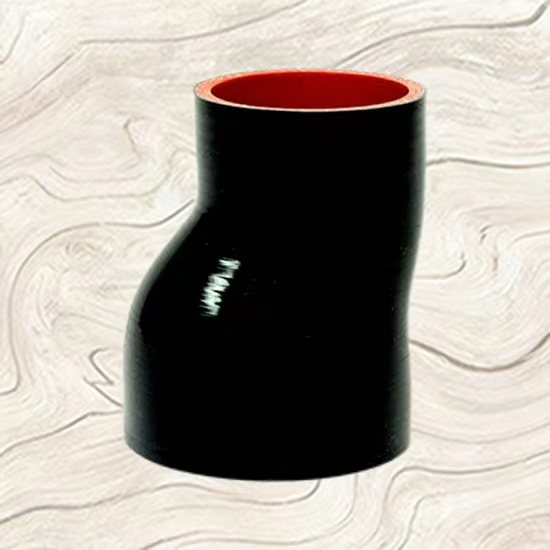
Custom Offset Silicone Hose Coupler Reducer for Misaligned Connections
Not every diameter transition happens along a perfectly straight centerline. In many mechanical assemblies, two connection points may have different diameters while also being physically offset from one another. A conventional straight reducer may technically connect the two ends but still create unnecessary stress or require additional bends in the hose or piping.
A custom offset silicone hose coupler reducer is designed for this type of routing challenge. The offset geometry allows the connection points to be positioned away from the same centerline, helping accommodate equipment layouts where a straight reducer would not provide the desired fit.
Key Scenarios for Offset Reducers:
- The connection points are not aligned: If two pipes are parallel but laterally displaced, an offset configuration provides a direct connection without forcing straight hoses into position.
- Installation space is limited: In a crowded engine compartment or equipment enclosure, small routing adjustments make installation significantly easier.
- Additional bends should be minimized: Using the correct geometry reduces the need for unnecessary adapters, sharp bends, or improvised routing.
- A standard reducer does not match the assembly: When diameter combinations or offset distances fall outside standard configurations, custom manufacturing delivers a direct fit.
RAINBOW lists its offset silicone coupler as a custom-configured solution featuring a four-ply reinforcement system and temperature-resistant materials. Providing accurate dimensional data during design is critical for exact specification.
When Is a 90 Degree Silicone Elbow the Better Choice?
When the primary requirement is a directional turn rather than a diameter step, a 90 degree silicone elbow hose coupler is designed to make that transition predictably without kinking.
Typical applications include:
- Coolant routing
- Engine compartment connections
- Turbocharger and intercooler piping
- Charge-air systems
- Industrial fluid transfer in compact equipment layouts
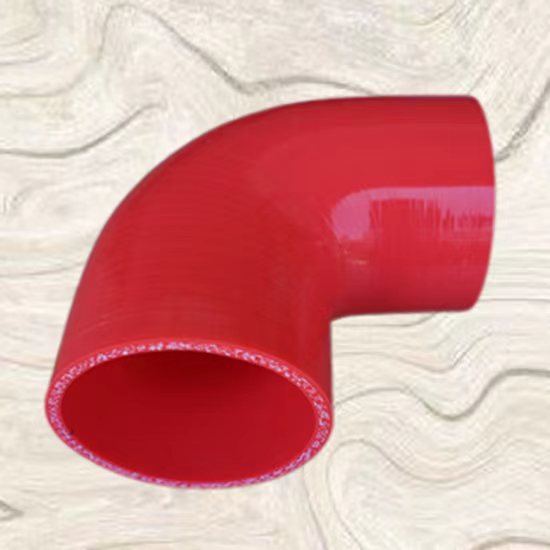
RAINBOW's 90-degree silicone elbow hose coupler delivers precision-engineered performance for demanding coolant and fluid transfer applications, utilizing multi-layer fabric reinforcement for high durability.
Offset Reducer vs. 90 Degree Elbow: Comparison
| Requirement | Offset Silicone Coupler Reducer | 90 Degree Silicone Elbow Hose Coupler |
|---|---|---|
| Different pipe diameters | Excellent choice | Depends on design |
| Lateral offset | Excellent choice | Limited |
| 90-degree directional change | Not the primary purpose | Excellent choice |
| Compact routing | Suitable | Suitable |
| Custom geometry | Available | Available |
| Complex equipment layouts | Suitable | Suitable |
| Coolant applications | Suitable | Suitable |
| Air/intake routing | Suitable depending on design | Suitable depending on design |
If diameter variance and centerline offset are the primary issues, choose an offset reducer. If the goal is a defined right-angle turn, a 90-degree elbow is standard.
What Should Buyers Consider Before Ordering a Silicone Coupler?
- Connection dimensions: Inner diameter (ID), outer diameter (OD), and connection depth for both ends. For reducers, clearly state both sizes.
- Overall length: Required overall length ensures proper clamp positioning and clearance.
- Routing geometry: For elbows and offset couplers, include the angle, centerline dimensions, or CAD drawings.
- Operating environment: Operating temperature range, pressure ratings, vibration levels, and fluid/air media.
- Reinforcement requirements: Multi-layer fabric reinforcement is critical for pressure retention and shape stability under vacuum or boost.
- Prototype or sample: Providing a physical replacement part or prototype simplifies reverse engineering and custom fabrication.
Why Customization Is Becoming More Important
As equipment packaging tightens across modern vehicle platforms, thermal management systems, and industrial machinery, connection components must fit system architecture natively.
Custom silicone couplers eliminate intermediate adapters, reduce leak paths, and streamline field servicing. RAINBOW's range spans vehicle silicone hoses, fuel cell hoses, intake/turbo hoses, and custom-molded geometry.
Common Applications for Universal Silicone Couplers
- Automotive and Performance Vehicles: Turbochargers, intercoolers, radiators, and air intake systems.
- Industrial Equipment: Machinery requiring vibration isolation, thermal expansion management, and flexible fluid transfer.
- New Energy and Fuel Cell Systems: Battery thermal management, power electronics cooling, and specialized fuel cell loops.
Frequently Asked Questions
Q: What is a universal silicone coupler?
A universal silicone coupler is a flexible hose component used to connect pipes, tubes, or components across standard geometries including straight, reducer, elbow, and hump designs.
Q: What is the difference between a silicone coupler and a silicone reducer?
A standard coupler connects identical pipe diameters inline, whereas a reducer transitions smoothly between two different pipe sizes.
Q: What is a custom offset silicone hose coupler reducer used for?
It joins two misaligned pipes of different diameters that do not share the same centerline, eliminating stress on rigid piping.
Q: When should I use a 90 degree silicone elbow hose coupler?
Use a 90-degree elbow when routing demands a sharp, defined right-angle turn without kinking or restricting flow.
Q: Can silicone hose couplers be customized?
Yes. RAINBOW manufactures custom geometries, plies, and dimensions based on technical drawings or physical samples.
Q: What information should I provide when requesting a custom silicone coupler?
Provide inner diameters for both ends, overall length, angle/offset dimensions, media type, temperature/pressure ranges, and reference drawings.
Choose the Right Coupler for the Routing Problem
The best silicone coupler is the one tailored to your system's connection geometry, thermal envelope, and mechanical stress profile. Identifying these variables early minimizes modifications and ensures reliable long-term service.
Explore Coupler Solutions: Visit RAINBOW Manufacturing's Universal Silicone Coupler line to review standard sizes, or submit your specifications, drawings, or physical samples for custom engineering support.